

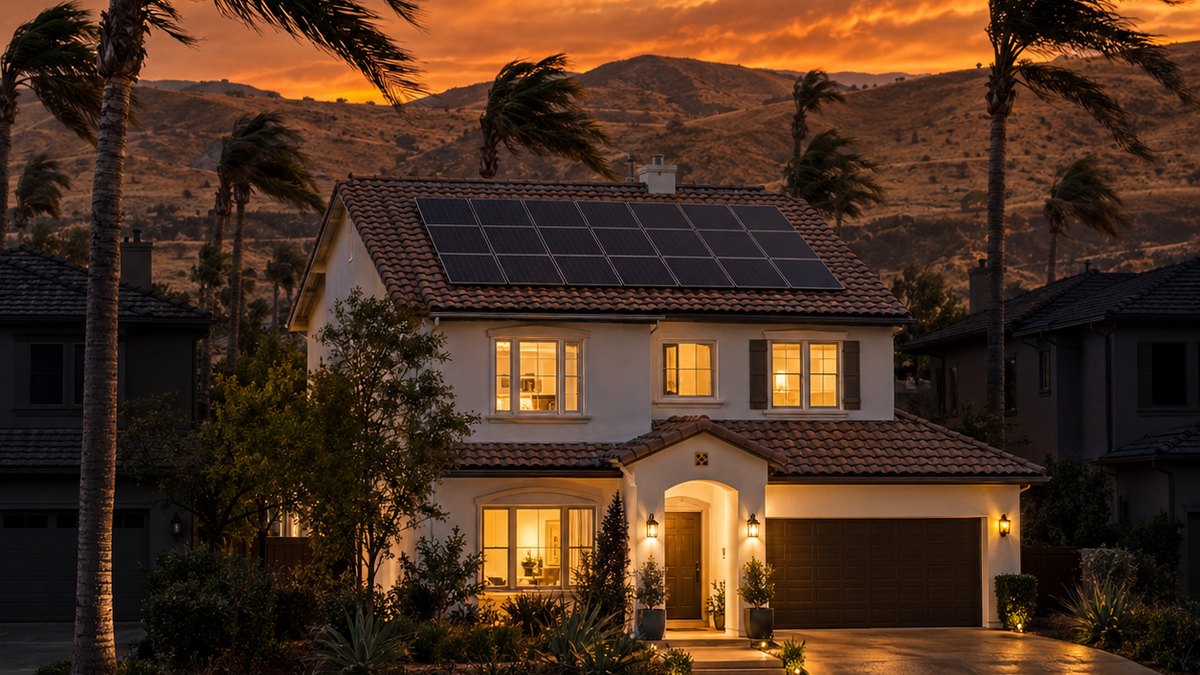
When SDG&E shuts off lines during fire weather, the outage is planned, announced ahead of time, and can last for days. That makes it the kind of outage a home battery handles best, as long as the system is ready before the wind arrives.
Key takeaways
- A Public Safety Power Shutoff is a planned outage: SDG&E turns off lines during fire weather so damaged equipment can’t spark a wildfire.
- Santa Ana season typically runs September through December, but shutoffs don’t always follow the calendar. Both of SDG&E’s 2025 events came in January.
- SDG&E’s notices usually start about 48 hours ahead, and a shutoff can last from several hours to multiple days.
- Solar panels without a battery go dark with the grid. A battery with a backup switch keeps the home running, and the panels recharge it every sunny day.
- Size backup around your essentials and set it up before fire season, not during a shutoff watch.
Frequently asked questions
What is an SDG&E Public Safety Power Shutoff?
A Public Safety Power Shutoff (PSPS) is a preventive outage. When wind, temperature, humidity, dry vegetation and input from fire agencies point to a high wildfire risk, SDG&E turns off specific circuits until the weather passes and crews can inspect the lines.
How much notice does SDG&E give before a power shutoff?
SDG&E’s customer notices typically start about 48 hours before a possible shutoff, followed by a confirmation a few hours before power is turned off. Alerts go out by phone call, text and email, and through the Alerts by SDG&E app.
How long does a PSPS last?
Anywhere from several hours to multiple days. Crews have to inspect every de-energized line in daylight before power comes back, and SDG&E’s January 2025 event ran from January 7 to January 16.
Will my solar panels work during a power shutoff?
Not without a battery. Grid-tied solar inverters are required to shut down when the grid goes down, so the house goes dark even on a sunny day. A battery with a backup switch disconnects your home from the grid, so the solar can keep running and recharging the battery.
How many Powerwalls do I need for a multi-day shutoff?
It depends on what you need running. Each Powerwall 3 stores 13.5 kWh. If your essentials use about 10 kWh a day, one Powerwall 3 can carry the evening and overnight, and a sunny day can refill much of what you used. Central air, pool pumps and EV charging raise the requirement quickly.
Most power outages are accidents. A Public Safety Power Shutoff is a decision. When fire weather builds in the backcountry, SDG&E can de-energize power lines on purpose so that a damaged line can’t spark a wildfire. For the homes on those circuits, the result is the same as any outage: no lights, no refrigerator, no Wi-Fi, no well pump. The difference is that you usually see it coming, and it often lasts longer than a typical outage.
That combination, advance warning plus long duration, is exactly where solar plus a battery earns its keep.
What a Public Safety Power Shutoff is
A PSPS is a preventive outage. According to SDG&E, the decision weighs wind speed and direction, temperature and humidity, how dry the vegetation is, field observations and input from fire agencies. When those conditions line up in high-risk areas, the utility turns off specific circuits until the weather passes and crews can inspect the lines.
You can see active and potential shutoffs on SDG&E’s PSPS dashboard, and SDG&E explains how decisions are made on its PSPS information page.
Why fall is shutoff season in San Diego
SDG&E describes Santa Ana wind season as typically running from September through December. Those hot, dry, offshore winds push down through the canyons of inland San Diego County, and they are the main reason shutoffs happen. They don’t always follow the calendar: both of SDG&E’s 2025 shutoff events came in January. And in early October 2026, SDG&E warned that nearly 35,000 customers, including parts of Poway and Ramona, could see their power shut off as fire weather moved in.
If your home sits in or near the inland foothills, plan for at least one shutoff watch each fall and winter.
How much warning you get
SDG&E monitors conditions days ahead. Its customer notices typically start about 48 hours before a possible shutoff, followed by a confirmation a few hours before power is turned off, updates during the event, and a notice when power is restored. Alerts go out by phone call, text and email, and through the Alerts by SDG&E app.
That lead time matters. Two days is enough to top off a battery, check which circuits are backed up and move the things you care about onto them.
How long a shutoff lasts
This is the part people underestimate. SDG&E says a PSPS can last from several hours to multiple days. Even after the wind dies down, crews have to patrol and inspect every de-energized line before power comes back, and SDG&E notes that inspection takes daylight, typically four to eight hours of it.
The January 2025 event shows the range: SDG&E’s own post-event report covers a shutoff that ran from January 7 to January 16 and affected more than 15,000 customers at various points. A plan that only covers one evening isn’t a plan for a PSPS.
Why solar panels alone go dark
If you already have solar, you might assume you’re covered. You’re not, unless you also have a battery. Grid-tied solar inverters are required to shut down when the grid goes down, so they don’t push power onto lines that crews are working on. On a bright, windy October afternoon, your panels will be producing and your house will still be dark.
What a Powerwall 3 does during a shutoff
A battery with a backup switch changes the picture. When the grid drops, a Tesla Backup Switch automatically disconnects your home from SDG&E’s lines. Your home becomes its own small, isolated system, and the Powerwall takes over.
- Storage: each Powerwall 3 stores 13.5 kWh.
- Power: it can deliver up to 11.5 kW continuously, enough to run most household loads at once.
- Solar recharge: the Powerwall 3 has a built-in solar inverter, so your panels keep charging the battery during the day while the grid is off. That’s what turns a one-night battery into a multi-day one.
- Storm Watch: once enabled in the Tesla app, Tesla’s Storm Watch charges the battery to full when alerts such as red flag or high wind warnings are issued for your area.
Sizing for a multi-day shutoff
Start with what you need to keep running, not with how many batteries you can fit in the garage. That’s the first question in any home battery backup plan in San Diego, and it decides everything else about the installation. A typical essentials list looks like this:
- Refrigerator and freezer
- Lights in the rooms you use
- Wi-Fi, phones and laptops
- Furnace fan or a window AC unit if it’s hot
- A well pump, if your property has one
- Medical devices, if anyone in the home depends on them
Add up the daily kilowatt-hours for those loads. If your essentials use about 10 kWh a day, one Powerwall 3 can carry the evening and overnight, and a sunny day can refill much of what you used. Central air conditioning, pool pumps and EV charging change the math quickly, which is why the design conversation should happen before fire season, not during a shutoff watch.
A pre-shutoff checklist
When SDG&E sends a watch notice for your area:
- Confirm your contact information with SDG&E so you get every alert.
- Make sure Storm Watch is on and the battery is charging to full.
- Know which circuits are backed up, and plug essentials into those outlets.
- Hold off on charging an EV from the battery during the shutoff.
- Keep the refrigerator and freezer closed as much as possible.
- Run large appliances like the dishwasher and laundry before the shutoff starts.
Get a backup plan built for your home
A Public Safety Power Shutoff is one of the few outages you can plan for, and solar plus a battery is the cleanest way to ride one out: quiet, automatic, no fuel and no extension cords. If you want a system sized to your essentials and your neighborhood’s shutoff history, Stellar Solar can design it with you. Stellar Solar has been San Diego’s trusted solar installer since 1998, A+ rated with the BBB and a repeat winner of San Diego’s Best Solar in the Union-Tribune Readers Poll. Call 866.787.6527 for a free evaluation, or get your free quote here.